











Robotics and Computer Vision: Is the World Ready for Disruption?
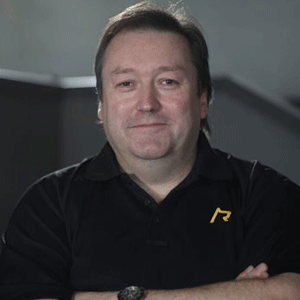
Dr Sue Keay, Chief Operating Officer, Australian Centre for Robotic Vision

Dr Sue Keay, Chief Operating Officer, Australian Centre for Robotic Vision
It’s an exciting time to be involved in robotics and computer vision research and to witness the advances that have been wrought by the adoption of deep learning. Algorithms can be trained to do amazing things and via networking, these learning’s can be distributed across computer systems and of course robots!
Thanks to accelerating advances in sensors, actuators, computation and machine-to-machine communication, we are reaching a tipping point in both robotics and computer vision where robots are gaining visual perception. This is the step required to make robots truly useful and safe to humans. By applying software algorithms for computer vision, robots are able to analyze and extract a range of useful information from images they capture using cameras.
"Robotic vision is the key enabling technology that will allow robotics to transform industries, disrupt markets, and ensure that robots become a common feature of the modern world."
No robot enters our robotics lab without something like a Kinect sensor being attached to collect visual information. Now Intel has developed Euclid, which acts as both camera and computer, making it easier to develop robots with vision capabilities.
But what do robots with vision look like? Some of the robots we have been able to create by combining vision and robotics include:
- An underwater robot that culls crown of thorns starfish – addressing an impending ecological crisis, which alone human divers cannot contain.
- An agricultural robot that can see the difference between weeds and crops and precisely
- A fruit picking robot that can harvest bell peppers and overcome the chronic shortage of labor during picking season.
And this is just the beginning. In the near future, computers will be faster, cameras will be cheaper and the need for robots will be pressing. The amount of data being collected by robots will be overwhelming and the pace of change will be relentless. We are already facing a skills shortage of people who are specialists in the fields of robotics, computer vision and data science. What does that mean for companies with no specialty in the disruptive technologies coming their way? What about companies without a CIO?
For smart companies, this will be the age of opportunity. Already companies like Tesla are harnessing the networked information they are collecting by applying truly agile manufacturing principles to address design challenges as they occur. What about other companies? In many countries, industry is dominated by small to medium-sized enterprises that have limited capacity to rapidly adapt to changing circumstances, particularly when the changes can have an impact over such a wide range of applications. For these companies, disruptive technologies are a big risk. How can they alleviate this risk and instead harness the opportunity?
First, work practices will need to fundamentally shift to lean and agile. Everyone who hasn’t already will be embracing entrepreneurship. The ability to pivot and adapt to changing circumstance or to drive change will become hallmarks of successful businesses. Adaptability will be a core competence for employees. Governments and legal systems will need to find ways to rapidly respond to new and unique situations with no relevant history or case law to rely on to help support decision-making and policy setting.
Next, knowledge will be distributed. The volume of information and the pace of change will mean that trusted intermediaries will form an important role as knowledge brokers to help companies navigate the complexities of ongoing disruption. The developers of disruptive technologies will increasingly have a moral obligation to ensure that people in all parts of the world understand the changes that are about to impact them. Distilling the vast pools of information that will be available into chunks that are digestible to the human brain will be an ongoing challenge.
Robotic vision is the key enabling technology that will allow robotics to transform industries, disrupt markets, and ensure that robots become a common feature of the modern world. Understanding this disruption is an opportunity in itself.
See Also: Top Robotics Technology Companies In Europe
